


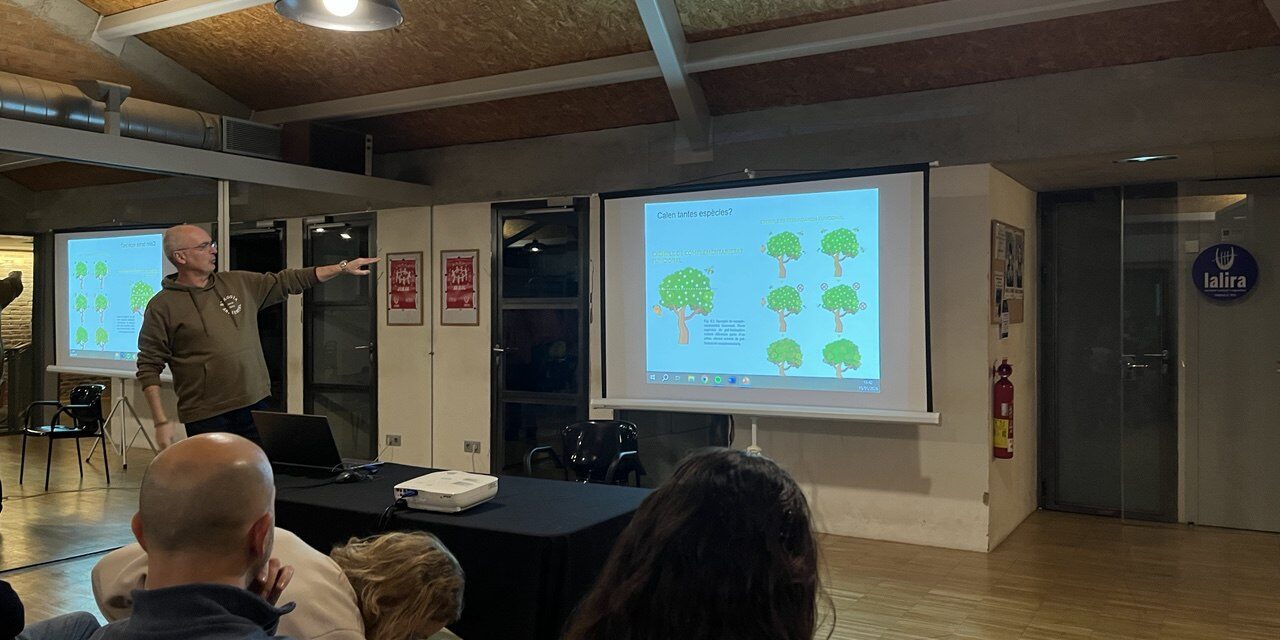
The other day we went to SCE La Lira in Sant Andreu, which now hosts the exhibition «More Than Bees», to attend a talk given by Anselm Rodrigo, focused on pollinating an Urban Garden in Barcelona. Anselm holds a PhD in Biology from the University of Barcelona (UAB), is a professor of ecology at UAB, a researcher at the Centre for Research in Forest Applications (CREAF), and a collaborator with the Environmental Classroom of the Sant Andreu district. A passionate enthusiast for bees and pollinators, with thorough knowledge of the subject. It was a pleasure to meet him and a true delight to learn from him.
He talked about the role pollinators wild bees, beetles, hymenopterans, butterflies… play in biodiversity and food production, in a holistic way, and then more specifically, focusing on the challenges and needs for their reproduction.
We learned many things, including how important it is to have different species of plants and that the same type of wild bee is not active throughout the year. The bees we see in spring or summer are not the same species; they have different periods of activity. For much of the year, 6 to 8 months, they are inactive, in closed niches where the larvae neither eat nor move. But after this time, they emerge and live between 1 and 3 weeks. While from November to January, due to low temperatures, the vast majority hibernate, from March to October there are 8 months in total during which we can enjoy great diversity… if we pay attention.
The practical case presented by members of the community urban garden at SCE La Lira, managed by different people from the center, was particularly interesting. They explained that they would like to plant some crops for which they would benefit from having pollinators. It’s a terrace on the second floor with great potential for growing various types of crops.
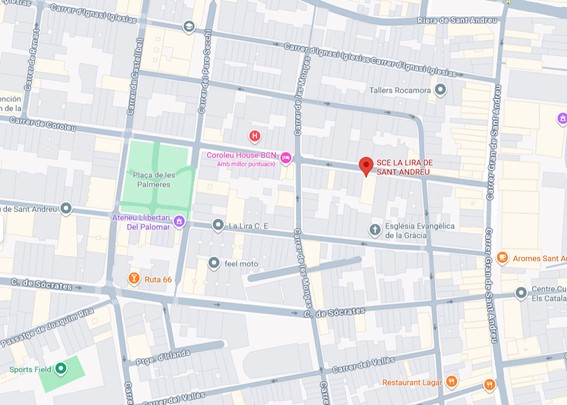
Anselm, without being catastrophic, drew our attention to the map and pointed out that right now the center is located in a fairly isolated area from green spaces, which makes it challenging to attract pollinators to visit the site. This is the center’s situation on the map:
This is the location of the center in the map:
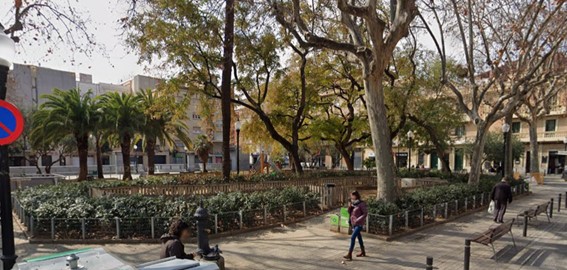
Although there is a square with a green area on the same street, which could serve as a small oasis (see attached photo), it currently lacks plants that promote biodiversity. Insects need an environment that allows them to feed during their flight period. To attract them and encourage their presence, there must be plants that bloom at different times of the year.
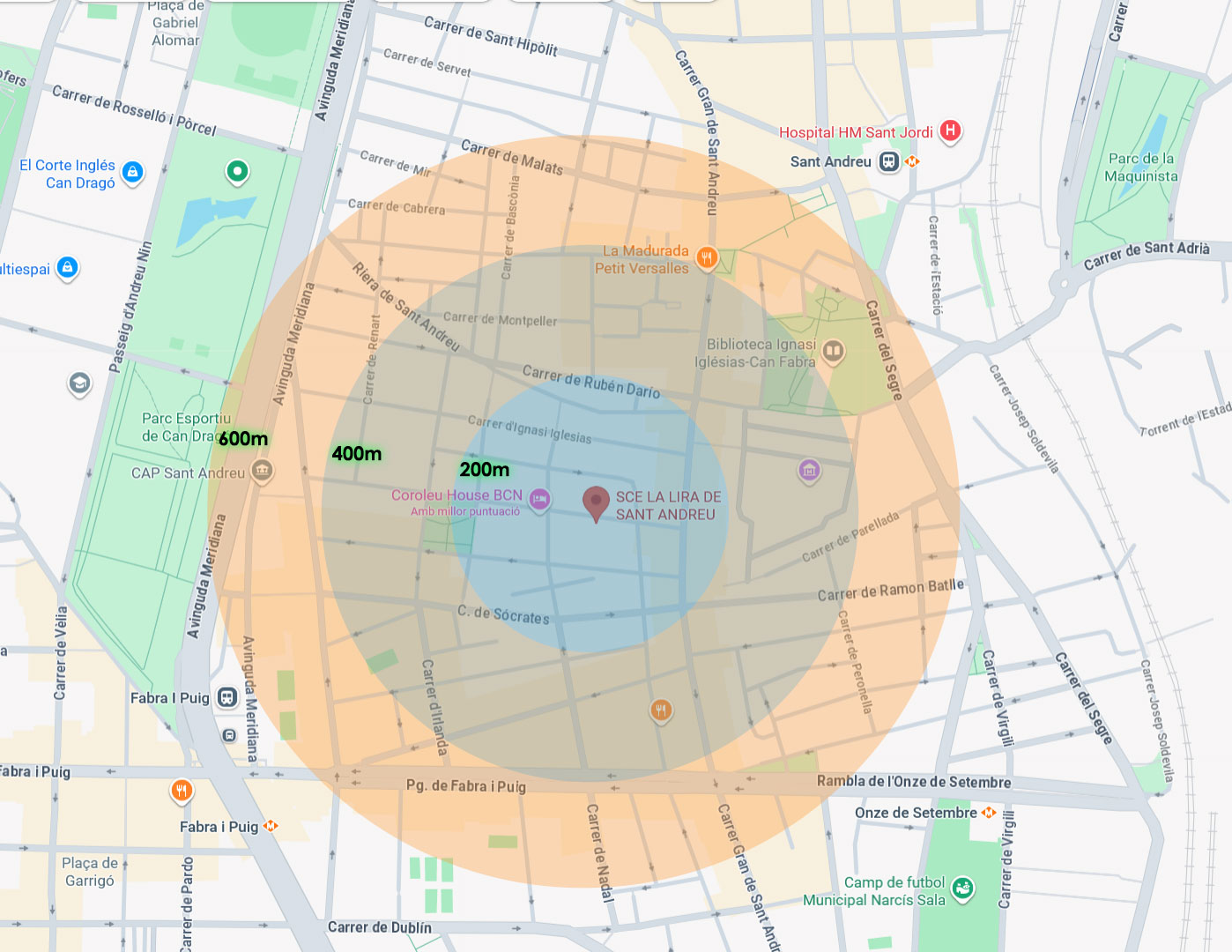
While honeybees can fly farther to obtain resources (an average of 1.5 to 3 km), wild bees have a much shorter range of activity, about 100 to 500 meters. This means there must be sufficient food sources nearby.
If we move away from the center on the map, we can see that there are certain green zones that could provide support. On the right: the Jardinets de Can Fabra, a beautiful space recently remodeled, but with very little (or no) flowering plants.
On the left, crossing a road with 8 lanes of traffic and strong wind currents (Avinguda Meridiana), we find the Can Dragó sports area. A zone that, although the map makes it look entirely green, is mainly composed of cut grass, without flowering areas.
Therefore, at the moment, it doesn’t seem easy to ensure crops are pollinated, but perhaps, by paying attention and becoming aware of the situation, we can now develop the land differently? From here, we encourage the City Council to take action!
In no way is this criticism. We fully understand that Barcelona’s situation doesn’t make it easy for Parks and Gardens or for making more or less economical proposals for maintenance, especially considering the years of drought we have accumulated. But there are creative ways to implement solutions that can make cities more biodiverse. We recognize the effort recently made in places like the reform of Plaça de les Glòries, for example, with pollinator hotels, and also that, many times, these flowers must be in protected areas so dogs don’t ruin them with their urine, which limits installation possibilities.
Moreover, with a small investment, it could be interesting to involve local residents through workshops in environmental classrooms and talks at Civic Centers, motivating them to care for plants on their balconies, thus creating green corridors and pathways.
Campaigns where people receive a flower + planter per household, explaining how to care for it, could help create a 2×1—more aesthetically pleasing streets + nutrients for pollinators.
This could be promoted by focusing on specific street blocks, encouraging networking through leaflets posted at building entrances. Although it’s always easier to engage with an entire residential community in a block of flats, the low-rise neighborhood of Sant Andreu could add an extra layer of neighborly connection for people who still don’t know each other because of different work schedules.
Many times, all it takes is a spark to generate interest in what surrounds us. Too often, people don’t invest in gardening because they have a busy schedule that doesn’t allow for even minimal research or investment, which would motivate them to make it a priority. But if this step is facilitated at the city level, supported by quarterly workshops and easier access to plants, tools, or interesting resources, perhaps then we can achieve a greener, more biodiverse city. Promoting life and caring for plants is deeply rewarding—something we can help discover through small actions.
And you? Would you join a neighborhood initiative like this? Let us know by sending us an email or joining our Discord server!
